

 Chloe Parker
An India IP address is an IP registered to a local Indian network or ISP, such as Reliance Jio, Bharti Airtel, or BSNL. When you use an India IP, websites can identify your connection as coming from an Indian user. This allows you to see localized pricing on Flipkart and Amazon.in, as well as India-specific search results on Google.co.in.
India is one of the world’s fastest-growing digital markets, with more than 800 million internet users and one of the largest online populations worldwide. For overseas e-commerce businesses, international apps, and SEO professionals, the demand for India IPs generally falls into four areas:
Before choosing an India IP, it is important to understand the four main IPs types. The type you choose directly affects reliability, speed, and cost.
| Type | Source | Trust Level | Speed | Best For |
| Residential IP | Home broadband connections from providers such as Jio, Airtel, and BSNL | ★★★★★ | Medium | Data scraping, SEO monitoring |
| Mobile IP | 4G/5G networks from Jio, Airtel, and Vi | ★★★★★ | Medium to low | Mobile verification and testing |
| Datacenter IP | Servers hosted in Indian datacenters | ★★ | Very fast | Low-protection targets, API requests, testing |
| ISP (Static Residential) IP | IPs registered to ISPs but hosted in datacenters and kept static | ★★★★ | Fast | Account management, long sessions, API whitelisting |
There are two important concepts to understand:
A rotating IP automatically changes after each request or session, depending on the provider’s configuration. This is useful for large-scale data scraping because if one IP becomes rate-limited, the rest of the task can continue using other IPs.
Indian platforms can have sophisticated anti-bot and traffic management systems, so datacenter IPs may face a higher risk of being blocked. For demanding scraping tasks, rotating residential IPs are generally a more suitable option.
A static ISP IP remains unchanged and combines some of the trust characteristics associated with residential networks with the speed and stability of server infrastructure.
This makes static ISP IPs useful for account-based automation and long-running sessions. Keeping the same IP for a specific account can provide a more consistent network environment.
Look for providers that support major Indian networks such as Jio (AS55836), Airtel (AS9498), BSNL, and Vi, ideally with ASN-level targeting. Some platforms distinguish between residential ISP networks and datacenter networks, so the ability to target specific ASNs can be important for advanced use cases.
Pricing, search results, and local services can vary significantly between Indian cities. Flipkart pricing, Google.co.in search results, and services such as Swiggy and Zomato may vary by city or even postal code.
If a provider only offers country-level targeting, it may not be suitable for tasks that require precise geographic localization.
Multi-step workflows on services such as IRCTC and MakeMyTrip may require a sufficiently long sticky session. Changing IP addresses in the middle of a session can interrupt the workflow or trigger additional verification.
Two factors are particularly important: the maximum sticky-session duration and whether static IPs are available.
Pay-as-you-go (PAYG) or “no extraction, no charge” billing models can be more flexible than mandatory subscription plans, particularly for businesses with seasonal traffic.
Support for both HTTP(S) and SOCKS5, together with username/password authentication and IP allowlisting, provides the compatibility required by most automation tools and technical workflows.
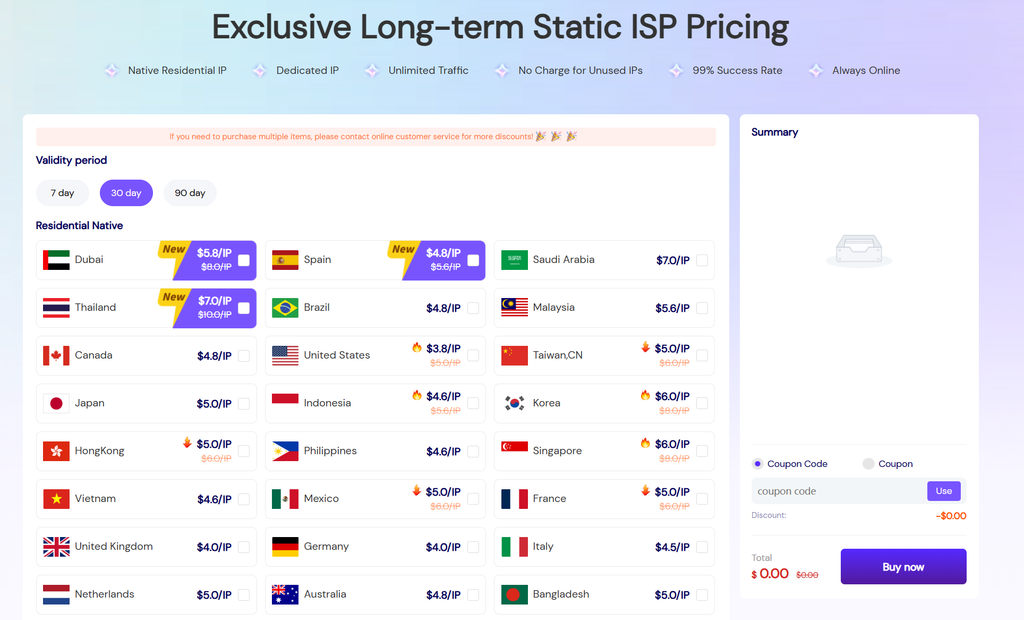
Best for: Overseas e-commerce sellers managing Flipkart or Meesho stores, automation teams targeting the Indian market, and users who need stable Indian exit IPs for long-running workflows.
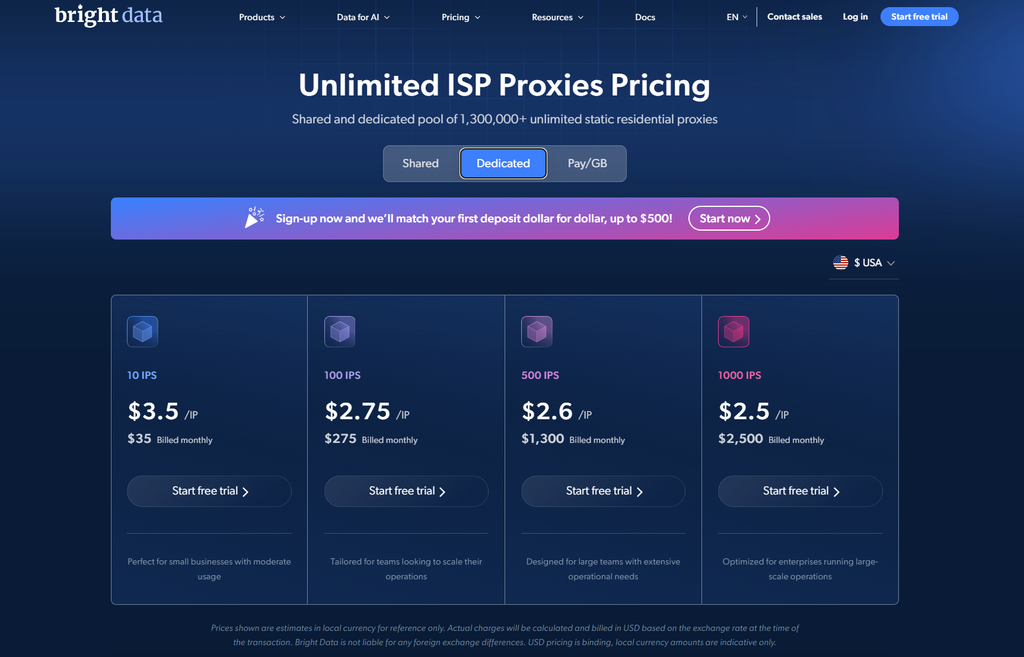
Bright Data offers a large residential IP pool in India, with targeting options covering country, city, ZIP code, and ASN. It also provides dedicated Scraper APIs for websites and services such as Flipkart, Amazon.in, and Google.co.in.
Pricing is approximately $2.50–$5/GB, depending on the service and plan. With a relatively high entry threshold, it is better suited to medium-sized and large teams with development resources.
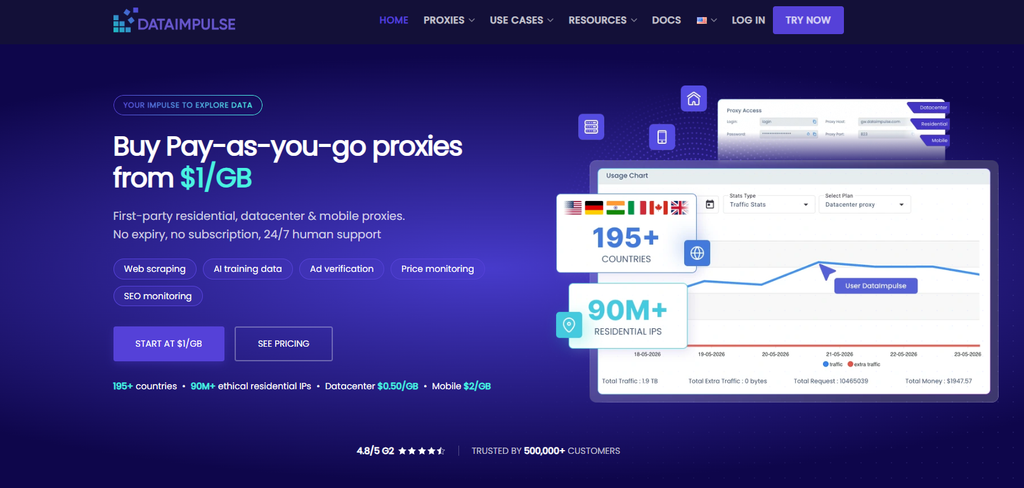
DataImpulse offers residential traffic from $1/GB on a PAYG basis, with traffic that does not expire. Its India IP pool supports state, city, ZIP code, and ASN targeting, with targeted traffic charged at approximately twice the standard rate.
If your primary requirement is large-scale data scraping and you do not need static IPs, DataImpulse is a low-cost option among GB-based residential ip services.
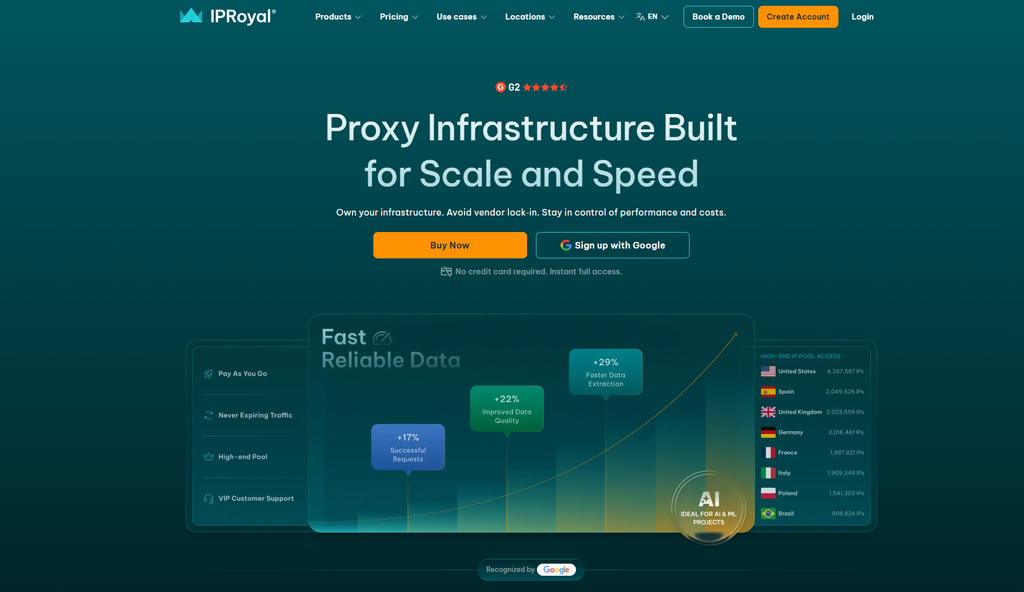
IPRoyal supports sticky sessions of up to 7 days. Residential proxies start at around $1.75/GB for larger volumes, while ISP proxies are available at around $2/IP.
Its long session duration makes it suitable for multi-step workflows such as those involving IRCTC and MakeMyTrip.
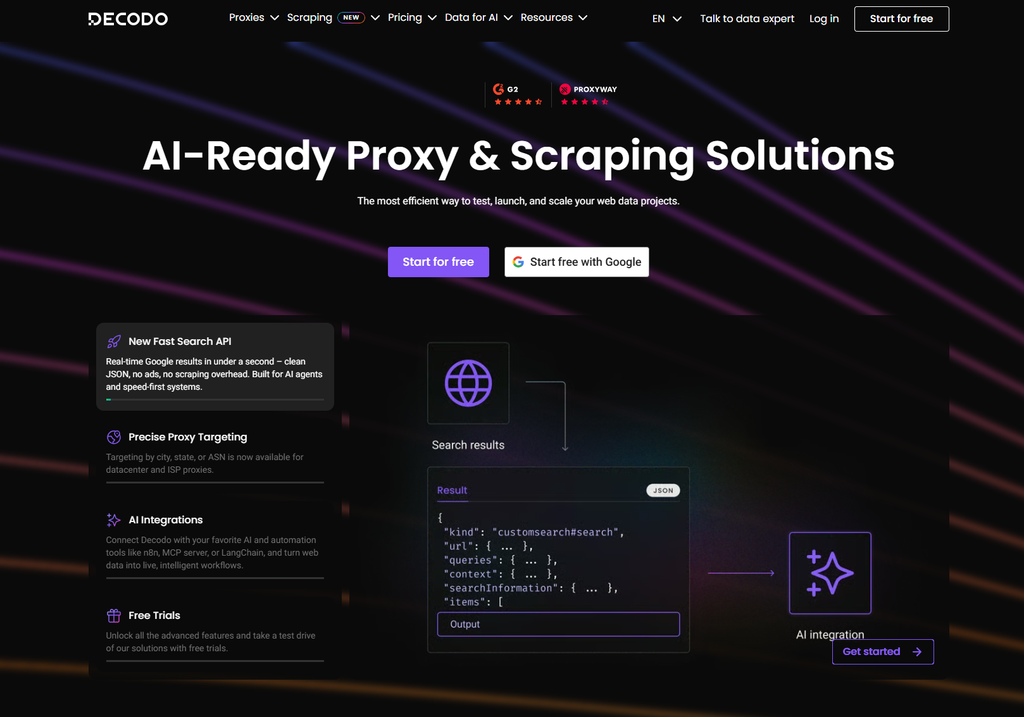
Indian ISP proxies start at approximately $0.27/IP, depending on available inventory, while residential proxies start at around $3.75/GB.
However, inventory for Indian ISP proxies may fluctuate. For business-critical workflows, it is worth having a backup provider available.
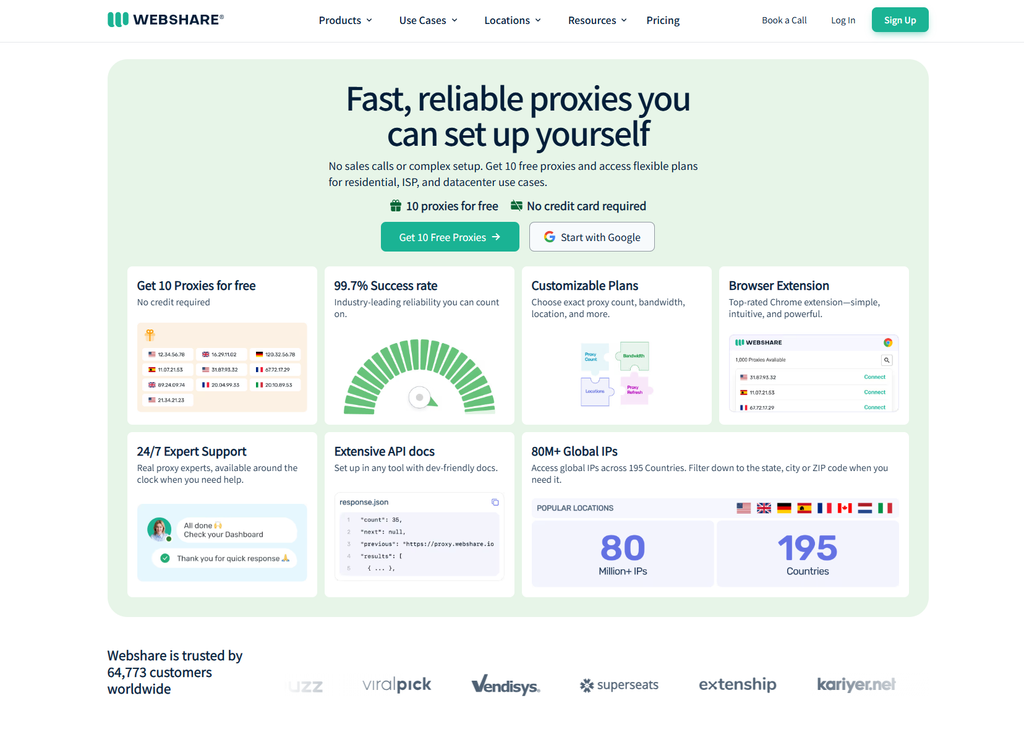
Webshare offers a free tier that can be useful for testing basic workflows, while paid residential proxies start at approximately $3.50/month.
Its targeting capabilities are primarily country-level, making it more suitable for low-protection targets and budget-conscious individual users.
| Provider | Indian Static ISP | Rotating Residential | City Targeting | Billing Flexibility | Chinese Support |
| Cliproxy ⭐ | From $2.4/IP, dedicated and unlimited bandwidth | From $0.04/IP, no charge for unused resources | ✓ | ✓ Traffic does not expire | ✓ 24/7 |
| Bright Data | From $35/IP/month | $2.50–$5/GB | ✓ ZIP/ASN | Medium | ✗ |
| DataImpulse | ✗ | $1/GB | ✓ 2× rate for targeting | ✓ No expiration | ✗ |
| IPRoyal | ~$4/IP | From $1.75/GB | Partial | ✓ No expiration | ✗ |
| Decodo | From $0.27/IP, depending on inventory | $3.75/GB | ✓ | Medium | ✗ |
| Webshare | ✗ | From $3.50/month | Country-level | Low | ✗ |
The bottom line is simple: free options can be useful for testing, but they should not be relied on for serious business operations.
| Method | How It Works | Risks |
| Public free IP lists | Publicly shared IP ports provided by other users | High risk: IPs may be heavily abused and can be blocked or become unavailable at any time |
| Free tiers from certain providers | A small number of free IPs provided by services such as Webshare | Suitable for testing, but pools may be limited, concurrency may be restricted, and Indian city-level targeting may be unavailable |
| Cliproxy new-user testing resources | Test traffic provided after registration | Useful for evaluating Indian IP quality, ASN information, location accuracy, and connection speed before purchasing |
Free IPs often have a history of abuse and may already have poor reputations in risk-control databases such as Scamalytics.
Using a heavily abused IP to access a business account can result in additional verification or other access issues. In other words, saving money on traffic may introduce unnecessary risks to the accounts and workflows that matter more.
Choosing the right residential IP is relatively straightforward once you identify your actual business requirements.
Most importantly, test before you commit to a large purchase. Contact the provider’s support team and request trial traffic or test IPs whenever possible. Use the free resources to verify IP quality, location accuracy, connection speed, and whether your workflow works as expected. Once everything has been validated, you can gradually increase your usage and investment.
Several factors can affect the pricing of India IP proxies:
IP type: Residential IPs are generally more expensive than datacenter IPs, while static ISP IPs are often priced higher than rotating residential IPs.
Traffic plan: PAYG traffic packages and unlimited-bandwidth plans have different pricing structures.
IP quality: Native Indian IPs with verifiable ASN information and accurate city-level targeting generally cost more than lower-quality or misleadingly labeled residential IPs.
Provider: Providers such as Cliproxy, Bright Data, and DataImpulse use different pricing models based on their infrastructure, features, and support.
Concurrency and usage limits: Higher concurrent connection limits and longer static IP retention periods can increase the overall cost.
Cliproxy provides a large pool of residential IP resources. However, pool size alone does not determine IP quality or whether a IP service is suitable for a specific business use case.
When choosing a residential IP provider, factors such as dedicated static IP availability, city-level targeting accuracy, and customer support can have a greater impact on real-world performance than the total pool size.
For product data scraping, rotating residential proxies are generally more suitable because the IP can be changed when a particular IP is rate-limited.
For account management, static ISP IPs are generally more appropriate because the IP remains consistent.
Cliproxy offers both options, allowing users to choose between rotating residential proxies and static ISP IPs based on their workflow.
Datacenter IPs generally offer the highest network speeds, with some providers supporting speeds ranging from 100 Mbps to 1 Gbps. However, datacenter IPs may also face a higher blocking rate on websites with stronger traffic controls.
If you need a balance between speed and IP reputation, static ISP IPs can be a more suitable option.
Yes, but mainly for testing rather than business operations.
Public free proxies are often heavily reused and may have poor IP reputations. Using them to access business accounts can introduce unnecessary risks.
A better approach is to use a provider’s free tier or trial resources to test whether your workflow works as expected before moving to a paid plan. For example, Cliproxy’s Indian static ISP IPs start at $2.4/IP, and the current coupon code lZvJcWBLCm provides a 5% discount.
The price depends on the ip type and billing model:
Static ISP: Approximately $2.4–$5/IP for 7–30 days
Rotating residential: Approximately $1–$3.75/GB
Datacenter: Can start at less than $1/IP
Because demand for Indian IPs can increase during major shopping and promotional periods, it is worth considering providers that offer non-expiring traffic or “no extraction, no charge” billing models.
Start your Cliproxy trial

Chloe Parker 2025-03-15 · 11 min read

Chloe Parker 2025-07-07 · 20 min read

Chloe Parker 2025-08-27 · 7 min read